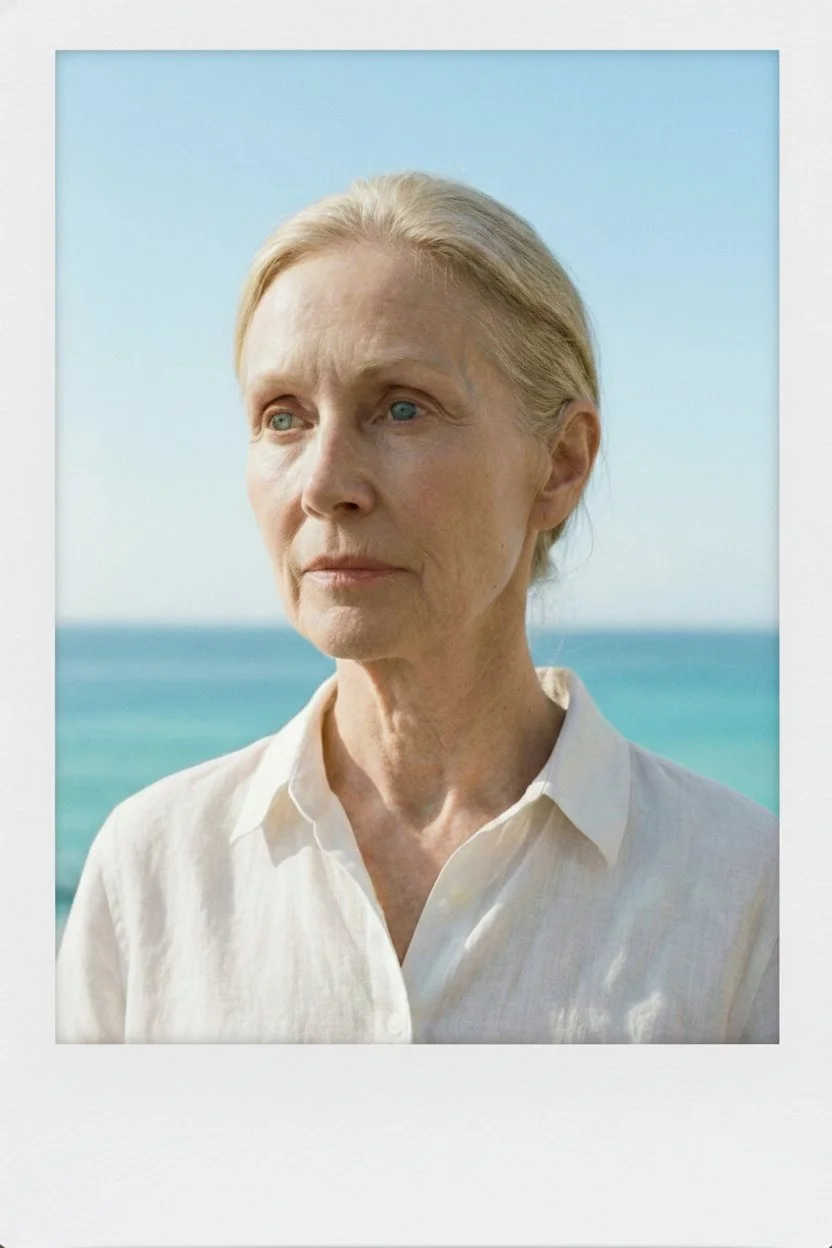
IF THESE WALLS
COULD TALK
ROOFTOP
ELENA
This is Elena’s story.
Each morning began the same:
The cup, the saucer, the steam.
The sun breaking across the rooftop.
She didn’t remember when the ritual began.
Only that it steadied her.
It anchored her.
Years ago, Elena had been someone. An actress, a singer. Guest arcs, nightclub sets, a face people recognized. Then... not.
She came back to Miami after her father, Walter, died. He’d moved here from Chicago. Bought the building, slowly. Not to own it, but to care for it.
He listened. He fixed things. And he listened to Sofia, a retired nurse with a piano on the second floor. By the time Walter arrived, Sofia had been in the building nearly forty years. No one knew what kept her, and her magnificent piano, there. But there she stayed. And she played. Chopin. Bach. And at times, when the light was just so, something original.
When Walter died, Elena came just to settle his estate. She meant to leave. But the hibiscus was blooming. And the building, the building was light.
So she stayed. She kept his rituals. Walked the halls.
It anchored her.
***
Over time, the edges of things began to blur. Gently, like fabric worn thin by weather. There was sorrow she had folded into silence for years: a daughter who no longer called, a marriage that dissolved without rage. And now the building itself felt under siege, as if bracing for a storm, like so many years before. Developers, an artist named Pierre, they circled like pressure systems, threatening to own what couldn’t be bought. It all carried the quiet fear of being erased.
She tried to push it all from her mind... and was mostly successful. Sometimes too successful: she began losing track mid-step, repeating small tasks, sweeping the same patch of porch twice in the same hour. She drew strange fountains on the backs of envelopes, tiered, impossible things, shaped like keys or flowers.
She saw rabbits too: conejitas, she would call them, small and silent, pausing in the shadows near the stairwell, watching her as if they knew something she had forgotten. And once, in the morning, she stepped onto the porch, hand to the wall, and with a small smile, whispered, softly, clearly, “Woo-hoo.” Her act of defiance.
Not long after,
silently, gently,
she was gone.
***
They found her on her seat by the piano. Sofia’s piano, which Walter had salvaged. Not fallen. Just still. As if waiting for the next note.
And in the piano bench, a score: three movements, Sofia’s hand. At the bottom, in pencil:
“If these walls could talk.”
And sometimes, when the light shifts just right... they do.